Sunday, January 25, 2015

Coinbase Is Opening The First Regulated Bitcoin Exchange In The U.S.

Fresh from scoring a massive $75 million funding round, bitcoin payment firm Coinbase has revealed that it will open the first regulated bitcoin exchange in the U.S. on Monday.

The company, which added the New York Stock Exchange and USAA to its list of investors last week, told the Wall Street Journal that it has “regulatory approval” in half of all states, including significant areas like New York and California. (The New York Department of Financial Services has been very vocal in its call for regulation via a proposed ‘BitLicense’.)

Coinbase already offers exchange services in 19 countries overseas, and it said that its work accruing necessary licenses and approvals in the U.S. took five months. The company will only be able to offer services to customers that sign up in states were it is approved, but there are plans to gain approval in further states.

Exchanges made via the Coinbase service will include a 0.25 percent commission fee that goes to Coinbase, although the company is giving customers two months of free trades to get things going.

The exact legality of bitcoin in the U.S. has been unclear for some time, so Coinbase’s news — and regulatory backing — is a significant mark in the sand.

The busting of Silk Road, an underground market for illicit goods where bitcoin’s anonymity made it a popular payment option, has doubtless eased some early opinions that bitcoin’s modus operandi was financing nefarious activity, but there’s still plenty of uncertainty about it as a digital currency. The price of a single bitcoin dropped as low as $185 this month — it is currently $263, but crossed $1,000 in 2013 — and it is unclear whether it has reached relative stability.

As for the Coinbase business itself, CEO Brian Armstrong is keen to explore the potential of bitcoin in emerging markets, and wants the company to expand its reach to at least 30 countries overall by the end of 2015.

Coinbase had a huge year in 2014, and its achievements included landing several big name retail partners — who began accepting bitcoin for the first time — including Overstock, Dell, Square, Mozilla and Wikipedia.

Friday, January 23, 2015

Twitter Adds Bing Translation Tool To Its Site And Mobile Apps

After toying with the feature for a couple of years, Twitter has officially added Bing Translator to its site, mobile apps for iOS and Android, and TweetDeck. Once users activate the tool in their account setting, they will see a little globe icon next to tweets in different languages. A translation appears below the original tweet once the globe is clicked.

The majority of Twitter users—77 percent—are based in countries outside the U.S., so it’s surprising that the site has taken so long to implement an in-line translation tool, which has been available on Facebook since 2011. An easy translation tool could potentially help companies that do marketing on Twitter reach more users without having to create separate accounts for different languages.

Twitter has run several experiments with the translation tool over the past few years, including adding the feature to TweetDeck earlier this month.

It was also added to Twitter’s mobile apps last year, but it proved to be unreliable and was quietly removed a couple months later.

In its announcement today, Twitter acknowledged that machine translations may be less than accurate, so it will display the original text above its translated version (though that is not particularly useful for people who can’t read the language in the first place).

This week has been a busy one for Twitter. In addition to the translation tool, it also launched its “While You Were Away” recap feature, which differs dramatically from the real-time experience Twitter is known for, and could potentially attract casual users who enjoy Twitter but don’t want to spend every waking minute glued to it to avoid missing out on conversations and tweets.

Twitter also confirmed the acquisition of India’s ZipDial, an interesting company that lets consumers call a number, hang up before they incur charges, and then receive a phone call or SMS with information about a business. ZipDial is designed to appeal to users in India, where data plans are relatively expensive, and may help Twitter build its business there.

Google pushes Firefox users to dump Yahoo search

Possibly alarmed at recent data suggesting the company is losing search share to rival Yahoo following Firefox’s move to start offering it as the default setting, Google has started taking action to try to lure users into switching to its own offering.

The situation changed last month shortly after Firefox-creator Mozilla announced it’d done a deal to start offering Yahoo as the default engine for searches made in the box at the top of the browser, in the address bar, or on its start page.

The arrangement, which brought to an end a 10-year partnership between Mozilla and Google, has already helped Yahoo to increase its share of the U.S. search market by a couple of percentage points, taking it to its highest share since 2009, according to data released earlier this month.


In a bid to prevent the figures from turning into a worrying trend for the Mountain View company, Google has started pushing out messages encouraging Firefox users with Yahoo search to switch to its own search engine.

Google has, for example, been posting messages at the top of its search page that show up when a user on Firefox visits its site.

“Get to Google faster. Make Google your default search engine,” the message reads, followed by the options “sure,” which leads to instructions on how to change to Google, and “no thanks.”

The company also this week tweeted a message saying, “This one’s for all the Google Search-loving Firefox fans out there,” accompanied by animated instructions on how to change the default search engine to Google.

But it’s not only Google who’s making a play for users – Yahoo, too, has been urging users to upgrade to the latest version of Firefox, which features Yahoo as the default search engine.

Getting search traffic is the key to increasing income for both Google and Yahoo, as more eyes and clicks on sponsored results equals more ad revenue.

Mozilla’s decision to swap Google for Yahoo means that if you’re in the U.S. and downloading Firefox for the first time, Yahoo will now show up as your default search engine.

However, if you’re an existing Firefox user and you haven’t previously changed your search default, you’ll have been offered the chance to switch to Yahoo when you updated to Firefox 34.

It’s too early to say if Google’s not-so-subtle tactics to claw back a few users is paying off, though the company evidently feels it has to be a bit more proactive about its approach or risk losing more users to Yahoo.

Wednesday, January 21, 2015

WhatsApp Comes To The Desktop

Are you one of the 600 million people on WhatsApp? Do you grow tired of having to type all of your messages through your phone? Good news!

There’s now a desktop version.

It’s a web app rather than a native client — and for now, at least, it seems to only play friendly with Google Chrome.

But if you’re ready to dive in, you can find the new web-ready version of WhatsApp right over here…

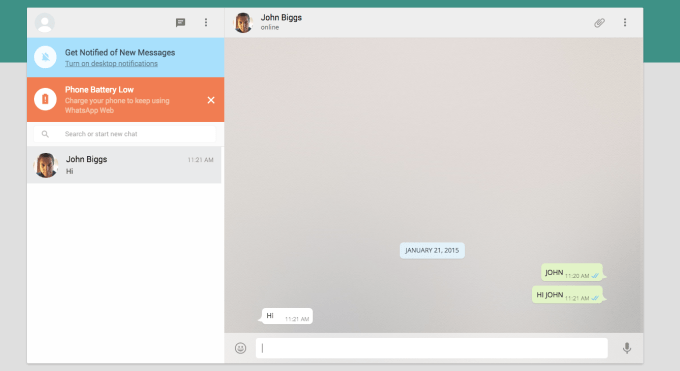
One weird catch: to log in on the desktop, you have to take a picture of a QR code through WhatsApp on your phone. This is necessary, presumably, because WhatsApp uses your phone number and SMS verifications rather than usernames/passwords. This currently works on Android, Windows Phone, and BlackBerry… but “due to Apple platform limitations” (WhatsApp’s words, there — we’re not sure what limitations they mean), iOS users are left out in the cold.

On the platforms where it works, however, it’s very slick.

Curiously, it seems as if it’s using your phone for more than just the initial login; note the orange warning in the screenshot below. If your phone dies, so does your WhatsApp web connection.

Monday, January 19, 2015

Magzter Launches Magzter Gold, Offering Unlimited Access To 2,000+ Magazines For $9.99 A Month

Startup Magzter is already selling many magazines on the web and mobile devices, but it’s been focused on traditional purchase models — buying single issues, or annual subscriptions to individual titles. Now, with the launch of a new service called Magzter Gold, the company is embracing the all-you-can-read (or watch, or listen to) subscription model popularized by Netflix and Spotify.


Magzter Gold, which will be available in the new version of the Magzter app, will cost $9.99 per month. It will provide unlimited access to more than 2,000 magazines, including Maxim, ESPN, and Fast Company. There will also be an option called Magzter Gold Lite, where you choose only five titles — but you’ll have access to the full archive of each one, and it only costs $4.99 per month.

Co-founder and CEO Girish Ramdas said the company has “always been toying with the idea” of a Netflix-style subscription, but it was “not the right time” until recently, when Magzter convinced a number of its publishers to try the model out.

This comes more than two years after the launch another Netflix-for-magazines service, Next Issue Media. (Next Issue recently raised a $50 million round from KKR.)

Asked about the competition, Ramdas suggested that Next Issue might have been “a little early” to the market, and he also argued that since it’s a joint venture of five big magazine publishers (Conde Nast, Hearst, Meredith, News Corp., and Time Inc.), it will have trouble attracting titles from other companies.

Whether or not you believe that, the services do seem to have distinct approaches. As I mentioned above, Magzter says there are more than 2,000 magazines available in the Magzter Gold library, while Next Issue says it has “over 140 of the best magazines in the world” — Next Issue CEO Morgan Guenther has told me he’s focused on “premium, high-readership titles.” (If you want to compare pricing, a basic Next Issue subscription is $9.99 per month, but you need to pay $14.99 if you want to read weekly titles like Time and The New Yorker.)

Does 140 versus 2,000 really make a huge difference? How many magazines can one person read, anyway? Well, Ramdas said that offering a variety of titles makes Magzter relevant to readers with a wide range of interests and backgrounds — for example, with magazines from the United Kingdom, Singapore, India, and elsewhere, Ramdas said it can help the “diaspora” in the United States keep up with news from home.


To be clear, though, Magzter is interested in big titles too, including those from the publishers backing Next Issue.

“Nobody has told us no — we’re in different stages of getting them on board,” Ramdas said. Co-founder and President Vijay Radhakrishnan added that even if a publisher is working with Next Issue (which is only available in the US and Canada), partnering with Magzter can help them reach a global audience, too.

Of course, searching through thousands of titles might be a little overwhelming, so Radhakrishnan noted that Magzter has also tried to improve discoverability — when you first open the app, it will ask you to identify you interests, and then provides personalized recommendations for magazines that you might want to check out.

Oh, and since Magzter has also started to support book publishers as well, Ramdan said a combined book-magazine subscription is a possibility in the future.

You can find links to the (numerous) Magzter apps on the company’s website.

Thursday, January 15, 2015

Rdio Becomes The First Global Music Streaming Service To Launch In India

India has welcomed the first international music streaming service to its shores after Rdio, the San Francisco based company, launched in the country.

Rdio’s arrival in India has been expected for some time since it acquired domestic streaming company Dhingana for an undisclosed price back in early 2014. Dhingana, which had over 10 million users at its peak, lost key deals with record labels, but Rdio’s entry is a different story since it comes with a vast library of 32 million songs, both international and India.

Rdio CEO Anthony Bay was keen to stress that the service will be an international-domestic hybrid in India.

“We’ve got a lot of respect for the music streaming companies that compete locally in India, that’s one reason that we entered by acquiring someone. We’ve brought that experience and DNA from Dhingana into Rdio’s India offering,” he told TechCrunch in an interview.

Bay said that India is Rdio’s largest office outside of the U.S., and he believes that there is a real opportunity to make a mark in the country thanks in no small part to the huge growth in smartphone ownership that is projected over the coming years.

The premium Rdio service will be priced at US$1.99 (INR 120) per month in India, but the company is also introducing it’s a free internet radio player for mobile in the country. That radio app has not been rolled out to all Rdio’s markets in Asia at this point, but Bay sees its potential to help the service reach consumers in India.

“We believe that classical experience of radio will appeal to many people in India, such is the broad audience of people who just want to listen to things,” he explained.

India has been a tough market for paid media services due to rampant piracy, but with a growing field of options – including rival services Gaana and Saavn – Bay believes that offering compelling alternatives is a significant step to reducing the amount of music piracy.

Rdio’s launch in India takes the service to 61 markets worldwide, and it also active in a handful of other countries in Asia. The company has plans to advance its presence in the region with more launches in Southeast Asia, and the introduction of its free radio service in more Asia markets too.

Bay said Rdio plans to reach 100 countries by the end of this year, but his mission is never over until “we have every song ever recorded on every device worldwide.”

How does China fall into that plan?

Bay said there has been demand from Rdio’s partners – including automobile and hardware companies – to have its service in China, and the company is “evaluating a lot of the ways to enter.”

“Yes, we would like to be in China in a thoughtful way,” Bay added.

Rdio doesn’t reveal how many users it has – paid or free – and that policy isn’t changing for now. Likewise, Bay didn’t give any information about user acquisition targets in India — but, as the first of the global services to enter, Rdio will be keen to make its large catalog of music makes its mark with consumers indiaspora.Competition-wise, n diaspora.

Competition-wise, Gaana offers a free radio service and premium packages priced from $3.99. It has a library of 3 million tracks, both international and domestic. While Saavn, the other major rival, also offers a free app, and gives full access to over three million songs Hungama.com ar $3.60 (220 INR).

Hungama.com and Australia-headquarted Guvera also compete, but Rdio’s initial pricing undercuts all of its competitors.

Amazon has also been rumored to enter the music market in India too. Last year it allocated a $2 billion to growing its presence in the country, though the primary focus of that is likely to be its e-commerce business, and entry into media is not out of the question.

The Indian market is increasing a target for overseas tech companies across a range of verticals, and with Rdio now arrived, it surely won’t be too long before others in the streaming business follow suit.

Snapchat reportedly asking brands $750,000 for ads (which disappear)

Snapchat users have been seeing ads in the Recent Updates section of the app since last October as the startup behind the messaging software seeks to build out its platform and pull in some revenue.

Just like the hundreds of millions of messages sent via the app every day, the ads don’t stick around forever, vanishing immediately after being viewed, or after a maximum of 24 hours.

But here’s an interesting tidbit – the startup is asking brands to cough up a whopping $750,000 a day to get their wares showing up on the service, Adweek reported on Wednesday.

In a bid to convince advertisers that it’d be money well spent, Snapchat is touting its service as “a TV-style commercial space with millions of viewers a day,” according to Adweek’s unnamed source.

An ad agency executive speaking on condition of anonymity said Snapchat “has minimums, and they are very firm on them,” suggesting the startup is confident there are plenty of brands out there willing to hand over such a huge amount of cash.

And it may be right. Up to now, McDonald’s, Samsung, Universal, Macy’s, and Electronic Arts have all posted ads on the service, though there’s really no way of telling if they actually paid top dollar (early bird discount, perhaps?). In addition, it’s not certain the brands would be willing to go on paying such a hefty sum over an extended period.

Snapchat hasn’t offered any recent information regarding how many people are using its app; the last we heard was that it had 100 million monthly users in August 2014, so perhaps we’ll be getting an announcement on the 200 million mark sometime soon.

Either way, there’s little doubt a ton of brands would love to reach the predominantly teenage user base, though the suggestion that the platform is currently unable to give marketers detailed information on how the ads are being viewed – as well as the fact that they disappear after only one watch – may be causing a number of brands to think twice before blowing $750,000 of their marketing budget on a day’s worth of Snapchat advertising.

One top brand executive told Adweek that Snapchat’s rates are “significantly higher than what’s competitive out there,” adding, “It’s difficult to go forward with a deal with Snapchat at the prices they’re quoting.”